Committee rotation
Written by the Incognito Core Developers. It describes the design Zephyrium started from; where Zephyrium differs, Differences from Incognito is authoritative.
Designers: @0xmerman, @duyhtq, @thaibao-incognito
Developers: @0xmerman
Design goals
Validator random substitution is an important component to keep the network secure. The design should satisfy these system goals.
-
Randomness. Randomness is a crucial building block to avoid the validators being compromised.
-
Liveliness. The substitutions should not violate the consensus engine.
-
Data availability. New validators should have complete block data to start working with existing validators right away.
-
Bandwidth. The substitutions should not significantly increase the message throughput peer connections.
Additionally, for the validator's own benefits, this design should also consider these user goals.
-
Idle time. The shorter a user has to wait to become a validator, the better the validator experience is. It's also more efficient to make use of their capital.
-
Staking amount. The smaller the staking amount is, as long as the system is still secure, the better it is for the majority of the users of the network.
Code change notes
The implementation will mostly affect only the beacon chain. The code for the beacon chain is in the blockchain package.
The parameters
Parameter fine-tuning is an important part of Incognito mechanism design. Parameter fine-tuning responsibility is initially handled by the core team, but will be and gradually transferred to the community once self-governance is implemented in early 2020.
| Parameter | Description |
|---|---|
| X | the required staking amount |
| N | the number of shards |
| M | the maximum number of validators per shards |
| K | the maximum number of substitutions per shard in an epoch |
| P | the maximum number of substitutes per shard |
| T | the number of blocks in an epoch |
| A | the ratio between substitutes and substitutions |
The validator role
The Incognito blockchain is composed of N+1 subchains: 1 beacon subchain and N shard subchains.
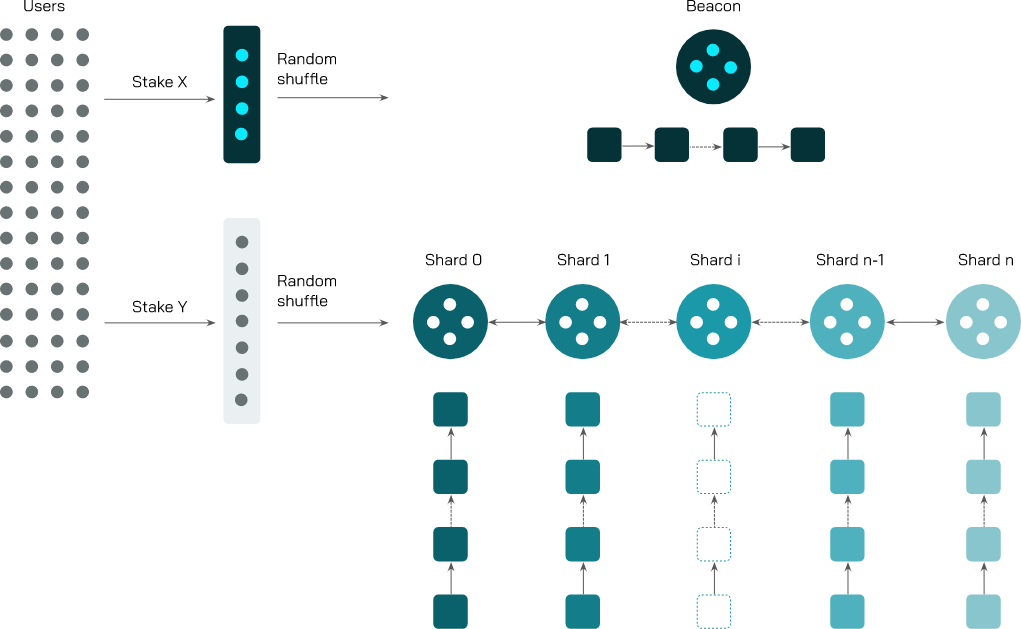
Each subchain is a Proof-of-Stake blockchain with its own committee of M validators.
-
The validators produce new blocks via a Practical Byzantine Fault Tolerance (pBFT) consensus algorithm.
-
Via a round-robin setup, each validator takes turns to become the block producer and proposes a new block to the committee. If at least (2/3)*M+1 validators confirm the validity of the block, the block will be added to the subchain.
-
Every epoch (or T blocks), the committee will be shuffled. K random validators in the current committee will be substituted by new validators.
The life cycle of a validator
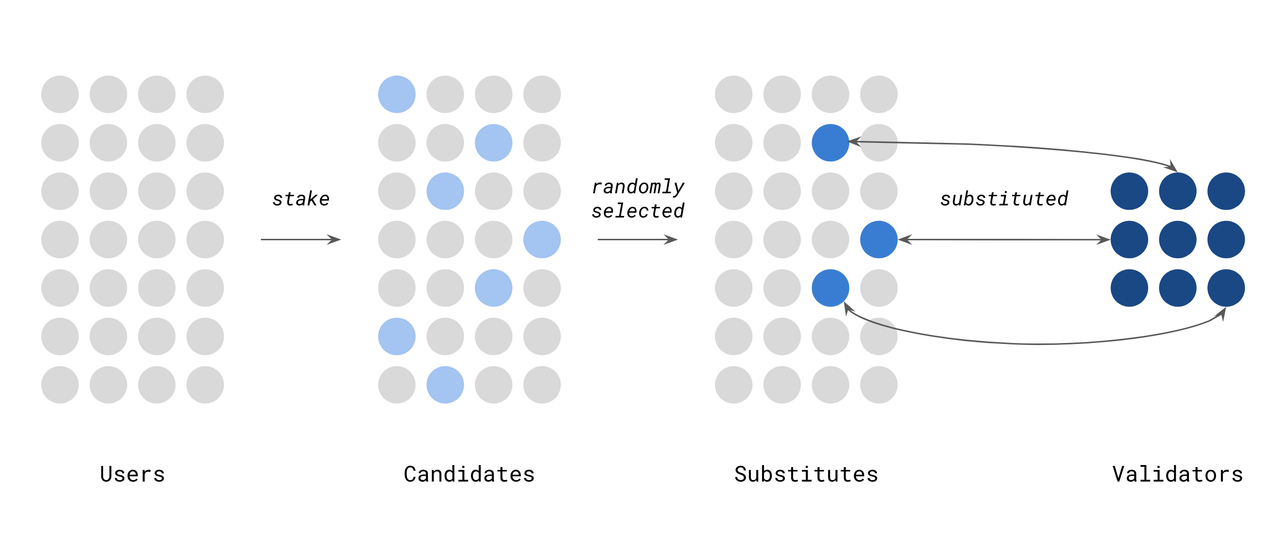
The life cycle of a validator is as follow:
-
The user stakes X amount of PRV to become a candidate.
-
The candidate is randomly selected to become a substitute for a specific shard S.
-
If the number of current substitutes is less than P, the candidate automatically becomes a new substitute for shard S.
-
Otherwise, the candidate will wait until the next epoch for the next random selection.
-
-
The substitute must sync all block data of shard S in advance.
-
If the number of current validators in shard S is less than M, the substitute automatically becomes a new validator for shard S at the next epoch.
-
Otherwise, the substitute will replace an existing validator in shard S at the next epoch.
-
-
The new validator starts producing blocks for shard S.
-
The ex-validator becomes a normal user and can manually stake again (go back to step 1). Note that there is an "auto re-stake" option for validators who don't want to manually re-stake.
What should be the value of K?
Because Incognito implements pBFT, it requires at least (2/3)*M+1 honest validators in a shard at all time. If we make too many substitutions at a time, it may significantly reduce the security of the shard.
The initial value of K is set as (1/10)*M.
What should be the value of P?
Because there are K substitutions per shard every epoch, P can't be smaller than K.
Additionally, we feel that there should be a buffer so that in case a substitute is offline or some substitutes need more time to complete block data syncing.
P = A*K
The initial value of A is set as 2.
Future work
Weighted random selection
Weighted random selection could further improve the design. We will explore various weighting mechanisms such as reputation-based (the number of blocks a validator has produced)or time-based (how long has a candidate been waiting to become a validator).
Random substitution
While the current solution select substitutes randomly from the candidate pool, the existing validators are being replaced as first-in first-out. Random substitution could further improve the design by selecting existing validators randomly.
A side note, this design could hurt validator experience as a user had been waiting for 10 epochs, just started working for 1 epoch, and now is being substituted. One idea is to set a threshold H so that only validators who work more than H epochs are part of the random substitution.